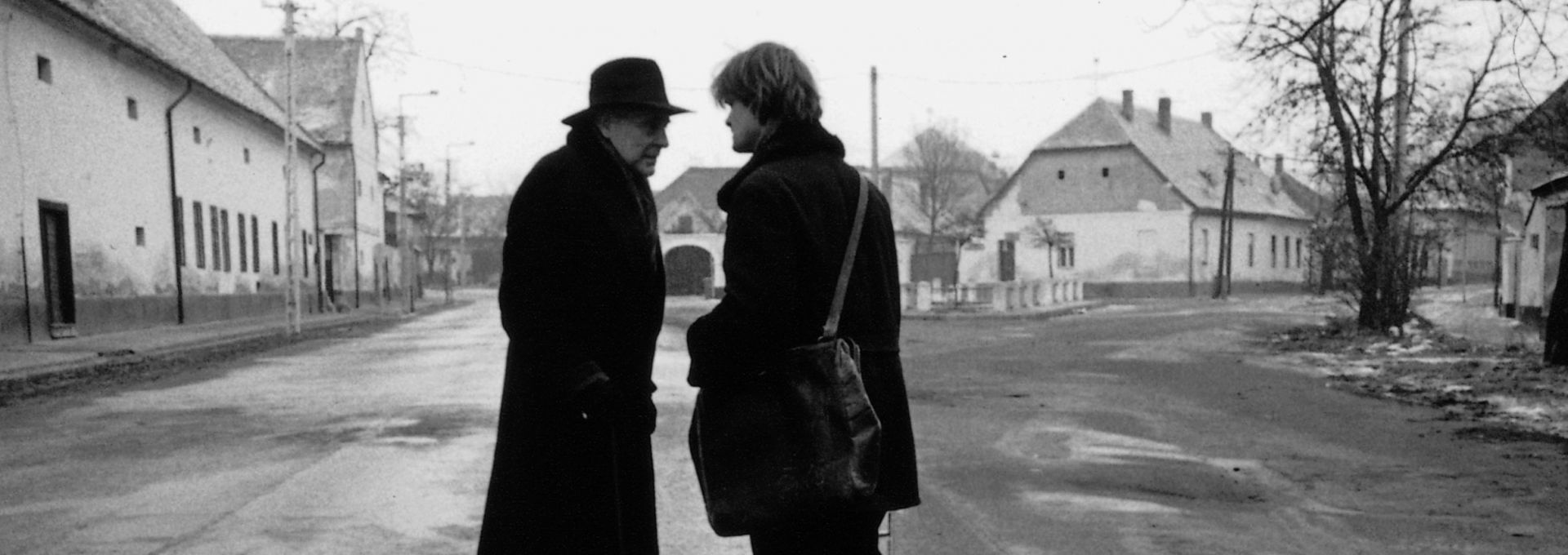
We were very saddened to learn of the passing of Hungarian filmmaker Béla Tarr. A pioneer of what came to be known as slow cinema, Tarr reshaped modern cinematic language and inspired generations of filmmakers with his uncompromising artistic vision. His films explored the fragility of human existence and the deep rhythms of life and time. His death marks a significant loss for the film world, but his body of work continues to influence and challenge audiences and artists alike. At the end of 2022 we were able to collaborate with EYE filmmuseum on a retrospective of his amazing work. As a tribute we now screen his film Werckmeister Harmóniák, which he made in 2000. We screen this film with English subtitels.
The inhabitants of a Hungarian provincial town gape at the main attractions of a traveling circus, such as the stuffed skeleton of a whale and a mysterious “Prince” who, like a true demagogue, attempts to take hold of the population and draws the town into a collective frenzy of destruction. Some residents lose their grip on events, while others try to profit from the disorder that ensues.
With Werckmeister Harmóniák, Béla Tarr completed the trilogy that also includes Damnation (1988) and Sátántangó (1994); the two earlier films were likewise made in collaboration with the Hungarian novelist and screenwriter László Krasznahorkai. All three films can be understood as a commentary on the fragility of human civilization. Unexpected and threatening developments bring out the animal nature of human beings and swiftly erode the mutual solidarity within a closed community. Tarr demonstrates how thin the veneer of civilization can be.
Béla Tarr (Pécs, 1955) studied at the Hungarian Academy of Film and Television in Budapest and rose to prominence in the 1980s and 1990s as Hungary’s foremost avant-garde filmmaker.